
- Best months
- June to October, late December
- Getting there
- Highway 101 between Lincoln City and Newport
- Bring
- Binoculars, a windproof jacket and patience
Highway 101 runs straight through Depoe Bay, along a low sea wall above the rocks, and many drivers barely notice the town before it is gone. Stop, though, and look over the wall. On one side is the open Pacific, breaking on black basalt and occasionally bursting up through holes in the rock. On the other, through a narrow gap in the cliffs, is one of the smallest working harbours anywhere, a calm basin crowded with fishing and charter boats. And out to sea, much of the year, there are whales.
The harbour through the rocks
The harbour at Depoe Bay is a small, nearly enclosed basin connected to the ocean by a narrow, rock-walled channel that passes beneath the highway bridge. Boats entering or leaving have to thread this gap, often with swells surging through it, and watching a boat time its run through the channel is one of the town's small dramas. In rough weather, the channel can become impassable, and boats wait inside until the sea calms.
The town has long promoted its harbour as one of the smallest navigable harbours in the world. Whatever the exact ranking, it is certainly tiny, and the view down into it from the bridge is memorable.
Spouting horns
Along the sea wall, the basalt shoreline is riddled with channels and lava tubes. When waves surge in, water is forced through narrow openings and bursts upward in plumes called spouting horns, sometimes high enough to spray across the highway. They work best at mid to high tide with a good swell running, and in winter storms they can be spectacular.
Watch from the sidewalk along the wall. The rocks below are slippery, wave-washed and dangerous, and people have been swept off them. If spray is reaching the road, so can a wave.
The whales that stay
Most gray whales pass the Oregon coast on their long migration between Mexico and the Arctic, but some stay all summer and into autumn along the central coast, feeding in the kelp beds and rocky reefs close to shore. Around Depoe Bay, a group of these whales returns year after year, and researchers have identified many individuals by the markings on their skin. They feed on small crustaceans in the shallow water, often within sight of land.
From roughly June to October, you have a good chance of seeing a whale from the sea wall on a calm day: look for the spout, a puff of mist that hangs in the air, then a long, mottled grey back rolling at the surface. Sometimes a whale raises its tail flukes as it dives. Patience and binoculars help.
The whale watching centre
On the sea wall in the middle of town, a state park whale watching centre has large windows facing the ocean, exhibits on the whales and, at many times of year, staff and volunteers who help visitors spot them. During the peak migration weeks, typically in late December and around late March, volunteers are stationed at viewpoints all along the Oregon coast to help people see the passing whales. Schedules change from season to season, so look them up before setting out. The centre is also a good place to warm up on a cold, windy day while still keeping an eye on the water through the glass.
Boat trips to see the whales also leave from the harbour. If you go, choose operators that follow responsible viewing guidelines, which require boats to keep their distance and avoid disturbing the animals.
How the whales feed
Gray whales are bottom feeders. Most of the year they suck up mud and sand from the sea floor and filter out small crustaceans and other prey with plates of baleen in their mouths. Near Depoe Bay, the summer whales also feed on tiny shrimp-like animals swarming in the water around the reefs and kelp beds. You may see a whale lying on its side near the surface, or a cloud of mud in the water where one has been feeding on the bottom.
Around Depoe Bay
North of the town, Boiler Bay State Scenic Viewpoint looks out over a rocky cove where the boiler of a wrecked ship can sometimes be seen at low tide, and seabirds and whales are often in view. South of town, the Otter Crest Loop is a narrow old section of the coast road that winds along cliffs through forest to Cape Foulweather, a headland named by Captain James Cook in 1778 for the stormy weather he met there. Its viewpoint, more than 500 feet above the sea, has one of the broadest views on the coast.
Further south, at Otter Rock, the Devil's Punchbowl is a collapsed sea cave whose roof has fallen in, leaving a huge round bowl into which waves surge and churn at high tide. At low tide, the tide pools nearby are among the best on the central coast, and the area is a marine reserve, where taking marine life is restricted.
Depoe Bay through the year
Summer and early autumn are the best seasons for the resident whales and for calmer seas. The migration peaks bring more whales in winter and spring, along with stormier weather. Winter storms make the spouting horns roar. Parking along the sea wall is limited at busy times. From Depoe Bay, the coast road continues south to Newport and Yaquina Head, or north toward Lincoln City and Cape Kiwanda.
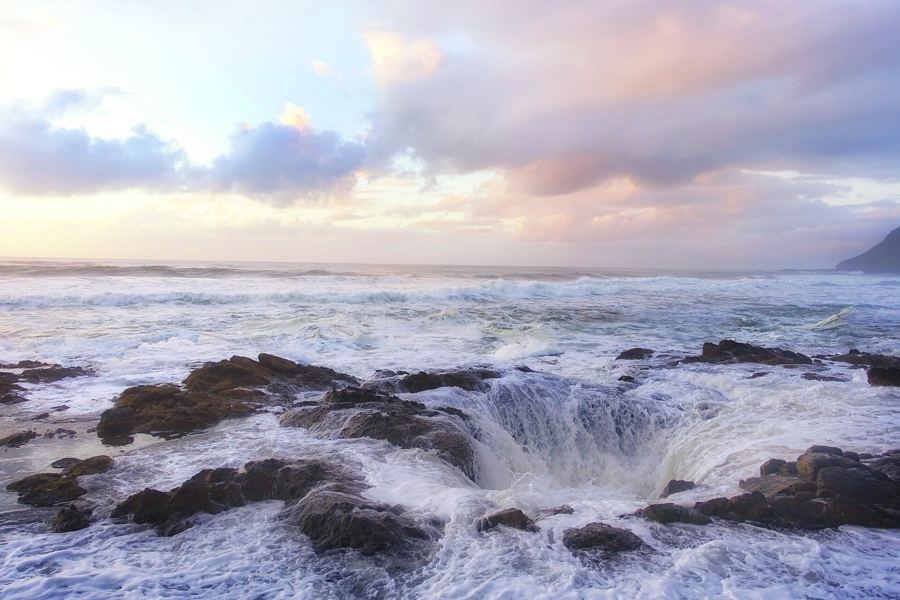 Photo: John Fowler from Placitas, NM, USA, CC BY 2.0