
- Best months
- April to September
- Getting there
- Highway 101, north side of Newport
- Bring
- Shoes with grip, a jacket, binoculars and a tide table
Just north of Newport, a narrow headland of dark basalt runs a mile out into the Pacific. At its tip, on a grassy point high above the waves, stands the Yaquina Head lighthouse, the tallest on the Oregon coast. Around it, the headland is protected as an outstanding natural area, managed by the federal Bureau of Land Management, with some of the best tide pools, seabird colonies and marine mammal viewing on the coast, all within a short walk of the parking areas.
The tallest light in Oregon
The Yaquina Head lighthouse was first lit in the early 1870s, a slender white tower nearly a hundred feet tall, built of brick. Its light still shines, guiding ships along the coast. Tours of the tower are offered at certain times, climbing the spiral staircase to the lantern room, though spaces are limited and schedules vary, so check before you go.
Even without a tour, the lighthouse grounds are worth the visit. The point offers wide views up and down the coast and out over offshore rocks crowded with birds. On calm days, look for gray whales passing or feeding close to shore.
Cobble Beach
Below the lighthouse on the south side of the headland, a long wooden staircase leads down to Cobble Beach, a small cove floored not with sand but with rounded black basalt cobbles, polished smooth by the waves. When the surf rolls in and then drains back out, the stones tumble against each other with a deep clattering, rumbling sound that is unlike anything else on the coast. Stand still for a few minutes and just listen.
At low tide, the rocks at the edges of the cove reveal rich tide pools with anemones, sea stars, urchins, chitons and more. Harbour seals often haul out on the rocks just offshore, especially in the pupping season in spring, when they must not be disturbed. Keep well away, keep voices down and do not try to approach. A seal that lifts its head and stares at you is already disturbed; back away until it relaxes.
The cobbles are hard to walk on. They roll underfoot, and wet ones are slippery. Move slowly, wear shoes with good grip and watch the waves; at high tide, much of the beach is under water.
Stand still for a few minutes and just listen.
Quarry Cove
On the north side of the headland, part of the land was once quarried for rock. When the quarrying stopped, the site was reshaped into an artificial intertidal area, Quarry Cove, with paths and gentle slopes that make it one of the most accessible tide pool areas on the coast, including for visitors using wheelchairs at suitable tides. Over the years, marine life has colonised the rocks, and at low tide the pools are full of animals. It shows how quickly the shore can heal when it is given the chance.
Seabird colonies
The offshore rocks at Yaquina Head, especially the one known as Colony Rock, host large nesting colonies in spring and summer. Common murres, black-and-white seabirds that look a little like small penguins, crowd onto the flat tops of the rocks in huge numbers, standing shoulder to shoulder. Cormorants nest on the ledges, and gulls, pigeon guillemots and black oystercatchers are common. Bald eagles sometimes raid the colonies, sending clouds of birds into the air.
A spotting scope at the lighthouse viewpoint is ideal. The noise and smell of the colonies, carried on the wind, are part of the experience. Murres lay a single egg directly on the bare rock, with no nest at all, and the egg's pointed shape helps keep it from rolling off the ledge. By late summer the chicks leap from the rocks into the sea, still unable to fly, and swim away with their fathers, and the colony falls quiet until the next spring.
A headland made of lava
Yaquina Head is made of basalt from the same great lava flows that built Haystack Rock and many other headlands on this coast. Millions of years ago, enormous eruptions far to the east sent rivers of molten rock westward across what is now Oregon and Washington, some reaching the sea. Where the lava met water and wet sediment, it cooled quickly, sometimes forming rounded pillow shapes and broken, glassy rock. Look closely at the cliffs near Cobble Beach and you can see some of these textures.
The basalt is much harder than the sandstone and mudstone on either side, so as the sea ate away the softer rock, the lava was left standing as a headland. The cobbles on the beach are pieces of it, broken from the cliffs and rounded by endless tumbling in the surf.
The keepers
Before automation, keepers and their families lived at the lighthouse, tending the lamp, winding the clockwork that turned the lens, cleaning the glass and keeping logs of the weather and passing ships. Life on the headland was isolated, especially in winter storms, and the work never stopped: the light had to burn every night of the year. Exhibits at the interpretive centre and in the lighthouse tell their stories, along with the ghost stories that seem to attach themselves to every lighthouse on the coast.
Inside the BLM centre
Near the entrance to the area, an interpretive centre explains the geology of the headland, the history of the lighthouse and its keepers, and the wildlife of the shore and sea. It is a good first stop, especially on a wet day, and staff can tell you when the next good low tide falls. An entrance fee applies to the area; check current hours and fees before you go.
Newport and the bay
The town of Newport lies just to the south, around the mouth of Yaquina Bay. Its working bayfront is full of fishing boats, processing plants and sea lions, which bark from the docks. The arched Yaquina Bay Bridge, built in the 1930s as one of a series of elegant bridges on the coast highway, crosses the bay mouth. On the south side of the bay are a large public aquarium and a marine science centre. The older Yaquina Bay lighthouse, a wooden building on a hill near the bridge, served only briefly before the light at Yaquina Head replaced it.
Newport through the year
For tide pools, aim for a minus tide in late spring or summer, usually in the morning. For seabirds, April to July is the peak. Whales can be seen in every season, most reliably during the winter and spring migrations and in summer when some feed nearby. From here, the coast road heads north to Depoe Bay or south past Waldport to Cape Perpetua.
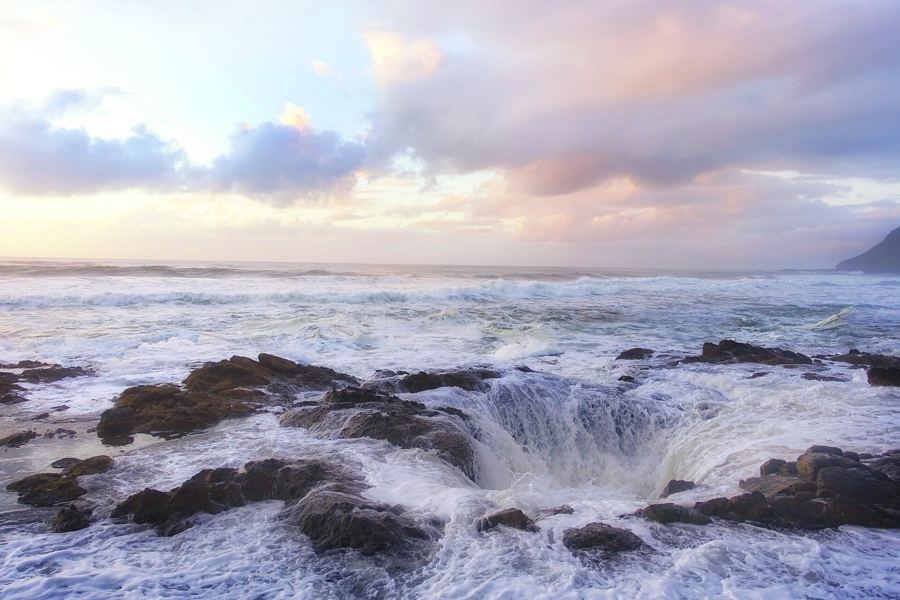 Photo: John Fowler from Placitas, NM, USA, CC BY 2.0