 Photo: Gary Halvorson, Oregon State Archives, CC BY 4.0
- Best months
- April to October
- Getting there
- Highway 101 to Bandon, then Beach Loop Drive
- Bring
- Tide table, waterproof shoes, a jacket and a camera
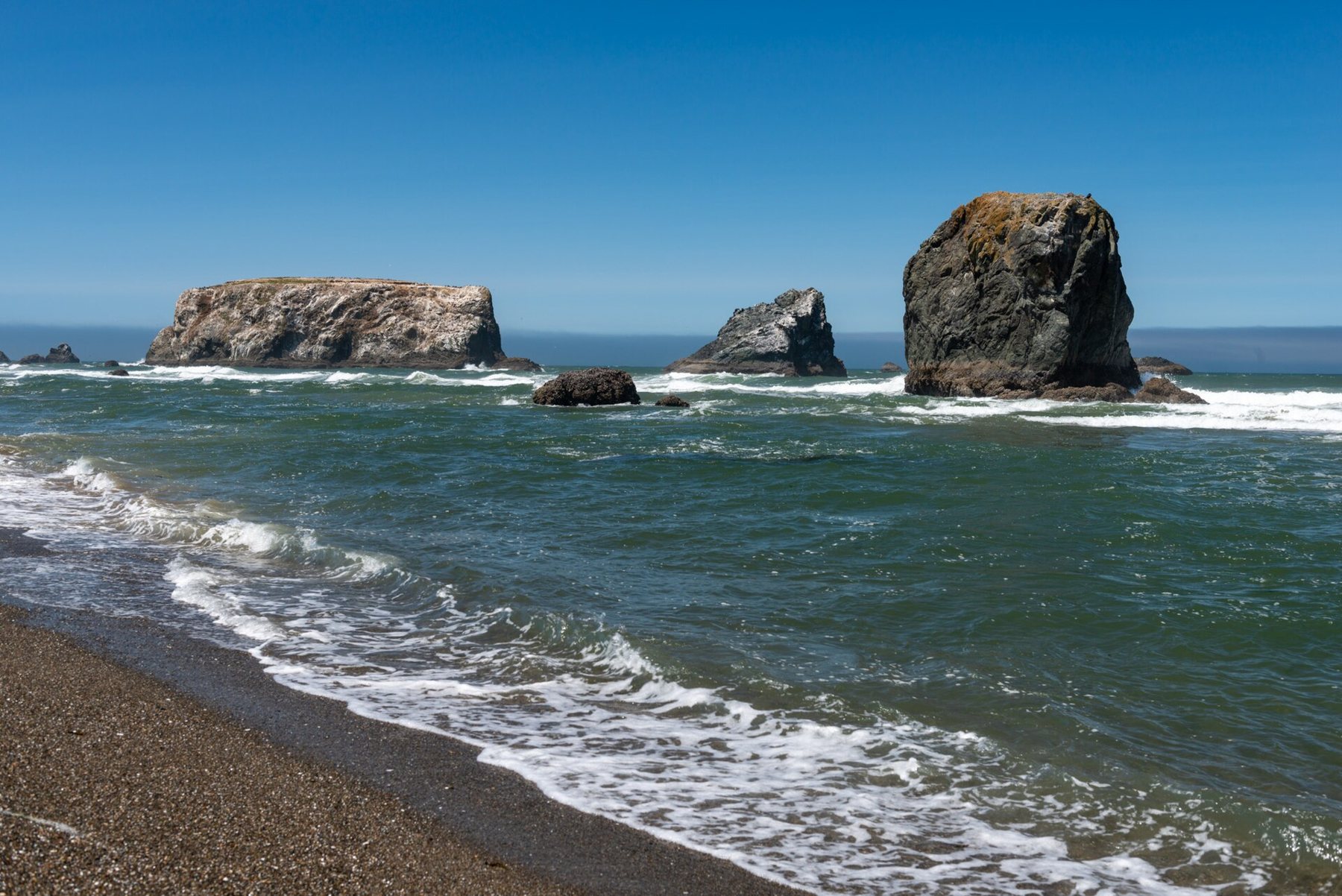
Many beaches on the Oregon coast have a sea stack or two. The beach at Bandon has dozens. South of the town, along a few miles of sand below a low bluff, rocks of every size and shape stand in the surf and on the beach: towers, arches, haystacks and jagged fins, some with caves through them, some crowned with grass and seabirds. At low tide you can walk among them, and at sunset, with mist hanging over the water, they are one of the most beautiful sights on the coast.
Face Rock
The most famous of the stacks is Face Rock, a large rock just offshore whose profile, seen from the right angle, looks like a face lying back in the water, gazing up at the sky. A state scenic viewpoint on the bluff above, along Beach Loop Drive, has the classic view, with a path along the top of the bluff and a stairway down to the beach.
A story is told locally, drawn from the traditions of the Native people of this coast, of a young woman who swam out into the sea and was caught by an evil spirit of the ocean, and who refused to look at him and so was turned to stone, still looking up at the moon. Smaller rocks nearby are said to be her dog and her cat and kittens, scattered by the spirit in the struggle. Versions of the story differ, and it is best heard from the Coquille and other tribal communities of the area, whose ancestors lived here for thousands of years.
Walking among the stacks
At low tide, especially on a minus tide, the beach below Face Rock and southward becomes a place to explore on foot. You can walk out to the bases of many of the stacks, peer into sea caves and through arches, and find tide pools in the rocks, with anemones, sea stars and urchins. The patterns of sand, water and rock change constantly as the tide falls.
Timing is everything. The beach between some of the stacks and the bluff is narrow, and at high tide waves reach the base of the bluff in places, cutting off coves. Check the tide table, walk out on a falling tide, and start back before the tide turns. Never enter sea caves when waves are washing into them, and keep away from the seaward side of rocks. Sneaker waves happen here as everywhere on the coast.
Timing is everything.
Coquille Point and the refuge
At the north end of the beach, near the town, Coquille Point is a headland with a paved path, interpretive signs and views over a group of offshore rocks that are part of the Oregon Islands National Wildlife Refuge. In spring and summer, the rocks are crowded with nesting seabirds, including common murres and tufted puffins, and harbour seals rest on the rocks below. The point is one of the best places on the southern coast for watching seabirds from land. Bring binoculars, find a bench out of the wind and give yourself time: the comings and goings on the rocks are endlessly busy, and peregrine falcons and bald eagles sometimes cause sudden panics among the birds. Stay on the path and respect the closures that protect nesting areas.
The Coquille River lighthouse
Across the mouth of the Coquille River, on the north jetty in Bullards Beach State Park, stands the Coquille River lighthouse, a small, pretty light built in the 1890s to guide ships across the dangerous river bar. It was taken out of service in the 1930s and later restored, and it now stands as a quiet monument at the end of the jetty, with gulls and pelicans on the rocks around it. The park has a long beach, trails, a campground and good views of the river mouth. The lighthouse is open for tours at certain times; check before you go.
A place to watch the light
Bandon's beach faces west across a wide sea, with the stacks scattered between the shore and the horizon, and the light here changes constantly. In the morning, the rocks are lit from the east and the sea is often calm and grey. In the evening, they stand in silhouette against the sunset, with the wet sand reflecting the colours of the sky. Fog, which often hangs over the coast on summer mornings and evenings, softens everything and makes the stacks appear and disappear. Photographers come back to this beach again and again for that reason.
Table Rock and the Cat and Kittens
Among the many named stacks, look for Table Rock, a broad, flat-topped rock near the north end of the beach, and the small group of rocks near Face Rock known as the Cat and Kittens. Further south, rocks with holes and arches give glimpses of the sea through them as the waves wash in. The best way to learn them is to walk the beach at low tide with the bluff on one side and the stacks on the other, stopping often.
Old Town and the river
Bandon itself is a small town at the mouth of the Coquille River, with an Old Town district along the waterfront, a boardwalk and a harbour where crabbers and fishing boats tie up. The town has burned more than once in its history; a huge fire in 1936, fed by gorse, an invasive shrub that burns fiercely, destroyed most of it. Gorse still grows along the coast here, its bright yellow flowers attractive and its oily stems a fire hazard. The town was rebuilt after the fire, and some of the older buildings in Old Town date from those years of recovery.
The town has a strong arts community, and its waterfront makes a pleasant base, with a boardwalk where you can watch the crab boats come in and the river meet the tide. Sea lions and seals often patrol the river mouth. In autumn, the surrounding area is known for its cranberry bogs, which are flooded for harvest, turning the fields into pools of floating red berries.
Bandon through the year
Spring and summer bring the lowest daytime tides, nesting seabirds and generally calmer seas, though summer afternoons can be windy and foggy. September and October often bring the clearest weather of the year. Winter storms make the stacks dramatic from the bluff, but the beach is dangerous then. For the dunes to the north, read walking into the Oregon Dunes; for the coast to the south, the Samuel H. Boardman corridor. And for how to explore the pools well, read tide-pool manners.